Proudly serving Phoenix, Mesa, Glendale, Scottsdale, Tempe, Chandler & surrounding areasCall or Text 24/7: 602-449-8153
Aerial view of Phoenix, AZ, showing desert foothills, saguaro cacti, and residential neighborhoods at sunset.

Hospital Discharge Transportation in Phoenix, AZ: Bedside-to-Door Patient Transfers & Care Coordination

Phoenix Non Emergency Medical Transport coordinates hospital discharge transportation throughout Phoenix and the surrounding metro. We provide wheelchair, stretcher, ambulatory, and bariatric transportation matched to each patient's mobility needs. Door-to-door staff assistance helps patients move from the hospital room into the vehicle and through the destination entrance. We also arrange senior, medical appointment, dialysis, and long-distance medical transportation when discharge is the start of ongoing care.

Hospital release times can shift, so our team coordinates directly with discharge planners at hospitals and skilled nursing facilities in Maricopa County. Trained medical transport staff handle patient transfers, mobility equipment, and vehicle securement as part of each trip. Drivers maintain current CPR and First Aid certification and current background checks. Every vehicle meets Arizona Department of Transportation vehicle safety requirements for passenger transport.

Phoenix spans 517.9 square miles of the Salt River Valley, with more than 1.6 million residents in the city and 5.19 million across the metro. Coordinated discharge transportation bridges the distance between widely separated hospital campuses and the home environment without relying on an unequipped sedan or rideshare.

Phoenix Non Emergency Medical Transport provides hospital discharge transportation throughout Phoenix and the surrounding metro, including Mesa, Scottsdale, Tempe, Glendale, and Chandler.

★ ★ ★ ★ ★4.9/5 Average Rating · 20+ Years of Experience · Thousands of Customers Helped · Licensed & Insured · Patients, Families & Care Teams

Hospital Discharge Transport Options

What Is Hospital Discharge Transportation?

Hospital discharge transportation is a coordinated, non-emergency ride from a hospital or skilled nursing facility to home, rehabilitation, or another care setting. It accounts for the patient's mobility level, release timing, and destination access before pickup.

Depending on the patient's condition, the trip may use an ambulatory sedan, lift-gate wheelchair van, stretcher van, or bariatric-rated vehicle. Staff assist with transfers and secure the patient and approved mobility or medical equipment for travel.

This service is especially important after surgery, cardiac care, or an extended stay when limited mobility, medication grogginess, or fresh incisions make a standard car difficult or unsafe. Facility coordination can also reduce delays that extend a hospital stay or interfere with follow-up care.

Benefits of Coordinated Discharge Transport

A planned discharge ride connects facility staff, the correct vehicle, safe patient handling, and the receiving destination in one coordinated trip.

  • Room-to-destination staff assistance
  • Vehicle selection based on mobility level
  • Transfer help for patients who cannot move alone
  • Wheelchair and stretcher securement systems
  • Accommodation for walkers, oxygen, and other approved equipment
  • Coordination with the facility's actual release time
  • Destination-access planning for stairs, ramps, and doorways
  • Companion seating when vehicle space allows
Patient-Matched Transportation

Hospital Discharge Transportation Services

Each discharge trip is built around how the patient can travel, what assistance is needed during transfer, and where the patient is going next.

Door-to-Door Hospital Discharge Transport

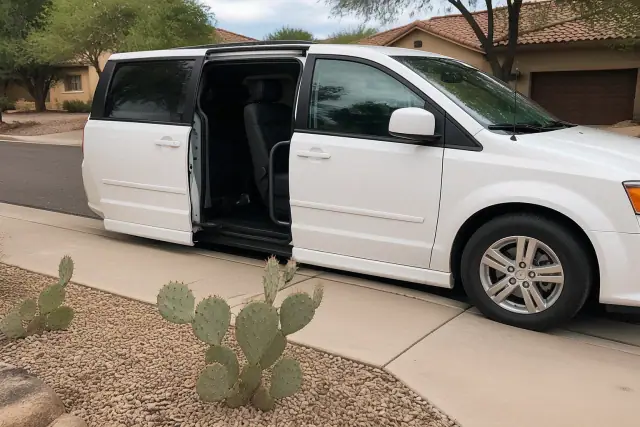
A transport vehicle with open side doors parked at a curbside in Phoenix, AZ, next to desert landscaping and stucco homes.

Staff assist from the hospital room through discharge, into the vehicle, and through the entrance at home or the receiving facility. Before the trip, the team checks the route for stairs, ramps, narrow doorways, and whether someone should be present to receive the patient.

Request Estimate

Wheelchair Transportation

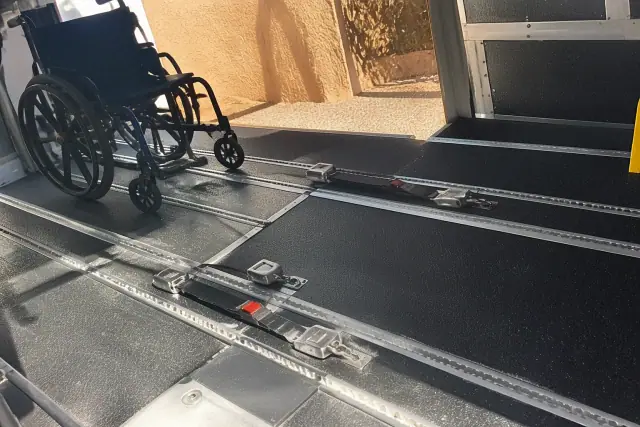
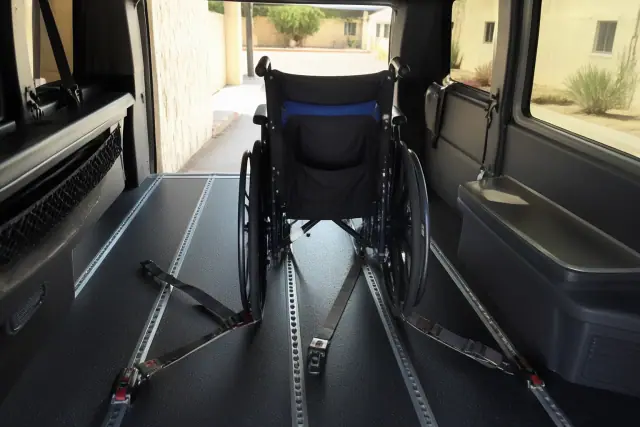
Wheelchair securement station with floor tracking and tie-down straps in a transport van in Phoenix, AZ.

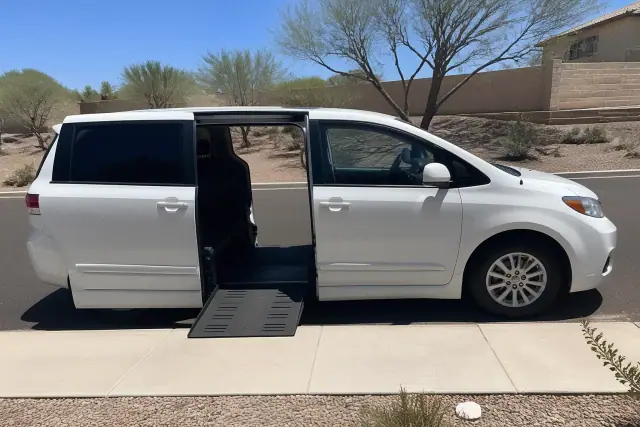
Lift-gate wheelchair vans and fold-down ramps support patients who cannot yet bear full weight or enter a standard vehicle. Standard and bariatric wheelchairs are secured with interior tie-downs and seatbelt harnesses before the van moves.

Request Estimate

Stretcher and Gurney Transportation

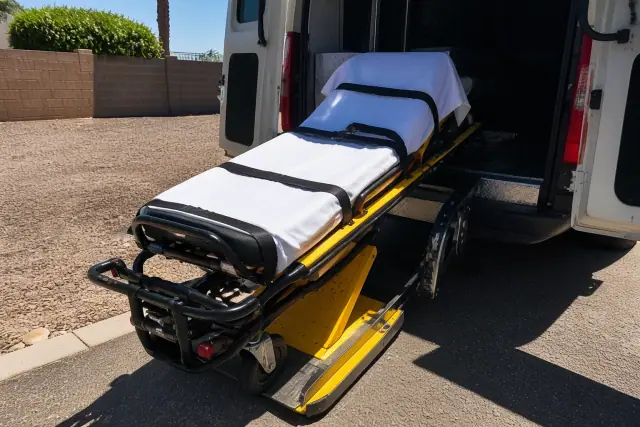
Stretcher being loaded into a transport vehicle for hospital discharge in Phoenix, AZ, parked on desert gravel.

Stretcher vans serve patients who cannot sit upright, have an unstable fracture, or need a fully reclined position after surgery or injury. Cot systems provide multi-point securement and adjustable head elevation, while climate control matters during Phoenix transfers where summer pavement temperatures regularly exceed 150 degrees.

Request Estimate

Ambulatory Transportation

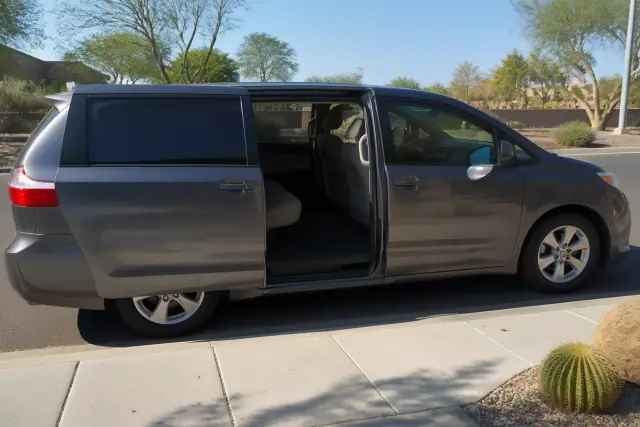
Open sliding door of a transport van parked curbside for hospital discharge in Phoenix, AZ.

Ambulatory service is for patients who can walk with minimal help but should not drive after sedation or a procedure. Staff can provide a steadying arm for stairs or curbs, and vehicles offer grab handles, lower step heights, and secure seating.

Request Estimate

Bariatric Transportation

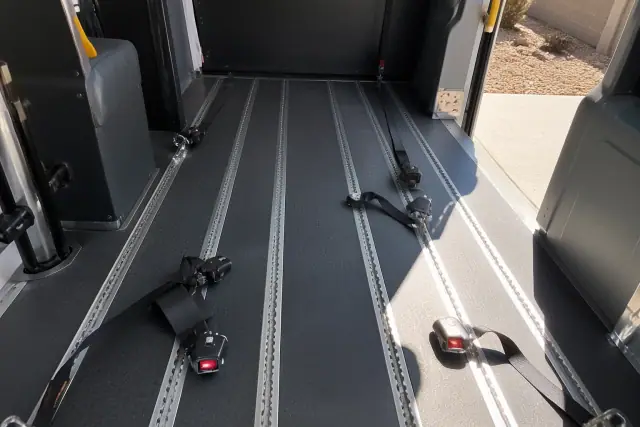
Interior of a bariatric transport vehicle showing wheelchair tracking and tie-down straps in Phoenix, AZ.

Bariatric transport uses vehicles rated for higher weight capacities, reinforced ramps, wider gurneys, and reinforced cots. The vehicle, equipment, and staffing are matched to the patient's transfer and securement needs before dispatch.

Request Estimate

Facility-to-Facility Transportation

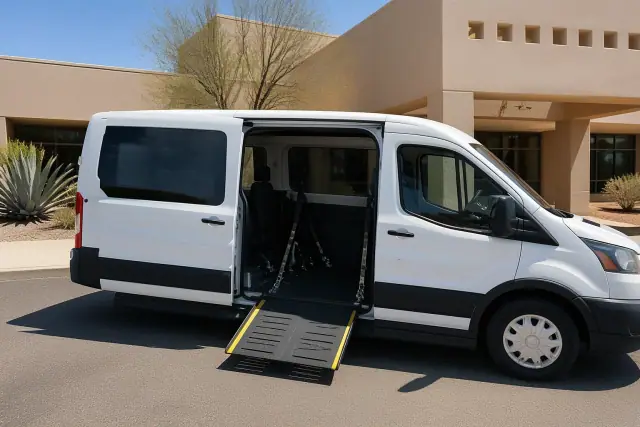
Accessible transport van with open side door and ramp at a medical facility in Phoenix, AZ.

Hospital-to-hospital and rehabilitation-facility transfers are available when the next level of care is not the patient's home. The team coordinates pickup and receiving details while accommodating the required wheelchair, stretcher, or attached medical equipment.

Request Estimate
Ongoing Medical Transportation

Continuing-Care Transportation Options

A hospital discharge may begin a longer course of care. Recurring and long-distance options help patients continue follow-up appointments, dialysis, rehabilitation, and facility transfers with a consistent mobility plan.

Medical transport vehicle with open side doors for passenger boarding at a curbside in Phoenix, AZ.

Senior Medical Transportation

Older adults may need extra transfer time, clear communication, and a slower pace when leaving the hospital or returning for care. Staff assist with practical details while protecting the passenger's comfort and dignity.

  • Extra time built into transfers
  • Clear, unhurried communication
  • Help with seatbelts and personal items
  • Blanket assistance when needed
  • A pace designed around mobility
Request Estimate
Medical transport vehicle with open doors at a curbside pickup in Phoenix, AZ, on a sunny day.

Medical Appointment Transportation

Scheduled medical transportation keeps follow-up care on track after discharge. Standing weekly or monthly rides can simplify planning, and clinic coordination helps account for appointment changes before pickup.

  • Primary care follow-up visits
  • Imaging appointments
  • Specialist visits
  • Standing weekly rides
  • Standing monthly rides
Request Estimate
A medical transport van with open side doors parked on a concrete surface in Phoenix, AZ.

Dialysis Transportation

Dialysis transportation is planned around fixed treatment schedules and recurring pickup times. Routes are commonly arranged three times a week so patients can reach each scheduled session with the appropriate vehicle and assistance.

  • Fixed treatment-time planning
  • Recurring route coordination
  • Three-times-a-week scheduling for most patients
  • Clinic pickup coordination
  • Mobility-matched vehicle selection
Request Estimate
Wheelchair secured in a transport van with four-point tie-downs and desert view through the door in Phoenix, AZ.

Rehabilitation Transportation

Rehabilitation transportation supports scheduled therapy and ongoing recovery after a hospital stay. Direct coordination with clinic staff helps the transport team confirm appointment changes and avoid a pickup based on an outdated schedule.

  • Scheduled therapy visits
  • Direct clinic coordination
  • Appointment-change confirmation
  • Planning that reduces wasted trips
  • Transport matched to mobility status
Request Estimate
Secured medical stretcher with safety belts at the rear of a transport van in Phoenix, AZ.

Long-Distance Medical Transportation

Long-distance service supports hospital-to-hospital trips, long in-state travel including Tucson, and transfers across state lines when a patient needs another facility. Each trip is planned around distance, vehicle type, medical-support level, and staffing needs.

  • Long in-state trips
  • Out-of-state facility transfers
  • Hospital-to-hospital transportation
  • Rehabilitation-facility destinations
  • Mileage, vehicle, and staffing-based quotes
Request Estimate
Choosing the Right Fit

Choosing the Right Discharge Transport Approach

The right discharge plan begins with the patient's ability to walk, sit upright, transfer, and travel with equipment. Those details determine whether an ambulatory sedan, wheelchair van, stretcher van, or bariatric-rated vehicle is appropriate.

Discharge-Plan Coordination

The team works directly with hospital and skilled nursing facility discharge planners so pickup timing follows the actual release process. Confirming the destination and receiving arrangements ahead of time supports a smoother handoff.

Trained Transport Staff

Medical transport staff routinely handle patient transfers and securement. Drivers maintain current CPR and First Aid certification and background checks, while staff training and vehicle inspection records are kept for referring facilities.

Mobility-Matched Vehicles

The fleet includes ambulatory sedans, lift-gate wheelchair vans, stretcher vans, and bariatric-rated vehicles. Matching the vehicle to mobility and equipment needs avoids trying to fit a post-hospital patient into an unsuitable passenger car.

Planning Around Patient Needs

Common Hospital Discharge Challenges

A safe transport plan accounts for mobility limits, medication effects, injury restrictions, destination access, available equipment, and release-time changes before the patient leaves the facility.

Discuss Transport Needs

Limited Weight-Bearing Ability

Many discharge patients cannot yet bear full weight or climb into a standard vehicle. Wheelchair transportation and staff transfer assistance provide an accessible path from the facility to the destination.

Medication Grogginess and Dizziness

Sedation and new medications can leave a patient too groggy or unsteady to drive or walk alone. Ambulatory assistance or wheelchair transport can be matched to the level of support needed.

Fresh Incisions or Unstable Injuries

Fresh incisions, spinal injuries, and unstable fractures can make upright seating inappropriate. Stretcher transport provides a fully reclined option with securement and adjustable head elevation.

Stairs, Ramps, and Narrow Doorways

Home access can change the equipment and assistance required at drop-off. The transport team confirms stairs, ramps, narrow doorways, and the clear path into the destination before the trip.

Unequipped Family or Rideshare Vehicles

A family sedan or rideshare may not have a lift gate, stretcher space, tie-downs, or trained transfer help. A medical transport vehicle is selected around the patient's mobility and securement needs.

Changing Hospital Release Times

Discharge timing can move as paperwork, medications, and final instructions are completed. Direct coordination with facility staff helps align the pickup window with the actual release instead of a guess.

How It Works

Our Hospital Discharge Process

From the first call through the destination handoff, the process confirms the release plan, patient needs, vehicle, equipment, and access details required for the trip.

01.

Share Discharge and Destination Details

Provide the hospital or facility pickup point, estimated discharge time, destination, and contact details for the person coordinating the release.

02.

Confirm Mobility and Equipment Needs

Explain whether the patient can walk, use a wheelchair, sit upright, or must remain reclined, along with any walker, oxygen tank, IV pole, or monitoring equipment traveling with them.

03.

Match the Vehicle and Staff

The team assigns an ambulatory sedan, lift-gate wheelchair van, stretcher van, or bariatric-rated vehicle and the staff needed for the planned transfer.

04.

Coordinate the Actual Release Time

Facility staff and the transport team align the pickup window with discharge paperwork, medication release, and the patient's readiness to leave.

05.

Secure the Patient and Equipment

Before departure, staff complete the transfer, check wheelchair brakes or stretcher positioning, secure the patient, and stabilize approved equipment for the ride.

06.

Complete the Door-to-Door Handoff

At the destination, staff assist the patient out of the vehicle and through the entrance, accounting for the planned access route and the person receiving the patient when needed.

Plan a Safe Ride Home

Schedule Hospital Discharge
Transportation in Phoenix

Booking 24-48 hours ahead offers the most flexibility for vehicle type and timing, while same-day transport may be available for an unplanned release. Trip quotes are based on mileage, vehicle type, and staffing needs.

Hospital Discharge Help

Hospital Discharge Transportation FAQs

These answers cover trip pricing, mobility options, coverage questions, booking, equipment, and what to expect when arranging hospital discharge transportation in Phoenix.

Call About a Discharge Ride

Private-pay trips in Arizona typically run $35-$60 for ambulatory sedan transport, $65-$115 for wheelchair transport, and $300-$525 for stretcher or bariatric transport, depending on distance and vehicle type. Scheduled or multi-stop trips may instead use hourly pricing of about $30/hour for ambulatory service, $70/hour for wheelchair or ambulette service, and $135/hour for stretcher service. Phoenix Non Emergency Medical Transport quotes each trip from mileage, vehicle type, and staffing needs before booking.

Phoenix Non Emergency Medical Transport offers hospital discharge, wheelchair, stretcher, ambulatory, bariatric, dialysis, medical appointment, senior, door-to-door, and long-distance medical transportation. Service is available throughout Phoenix and the surrounding metro, including Mesa, Scottsdale, Tempe, Glendale, and Chandler, with additional service in Tucson.

Ambulatory service fits patients who can walk with minimal help, wheelchair vans support patients who cannot enter a standard vehicle, and stretcher vans serve patients who must remain reclined. Bariatric vehicles provide higher-capacity equipment when needed. The patient's mobility, transfer needs, and attached equipment determine the appropriate option.

AHCCCS, Arizona's Medicaid program administered by the Arizona Health Care Cost Containment System, covers non-emergency medical transportation for eligible members when medical necessity requirements are met. That can include hospital discharge and dialysis trips. Eligibility is typically verified before the ride.

Book as soon as the facility has an estimated release time, ideally the day before. Same-day medical transportation may be available for last-minute discharges, but vehicle and staff availability can be more limited. Weekday mid-mornings and early afternoons are typically the busiest windows across Phoenix hospitals.

Most ambulatory and wheelchair vehicles can usually accommodate one companion. Stretcher vans may have less passenger space because of the equipment on board. Companion seating is confirmed when the trip is booked.

Original Medicare generally does not cover non-emergency transportation for routine appointments or hospital discharges; it primarily covers emergency ambulance transport when other transportation would endanger health. Some Medicare Advantage plans include limited non-emergency transportation as a supplemental benefit. Patients should check the details of their specific plan before the trip.

Expect a confirmation call, an arrival window, and a staff member who introduces themselves before providing transfer help. The team verifies discharge paperwork, confirms the destination, and checks that stairs, ramps, narrow doorways, or other access needs were addressed. The patient and approved equipment are secured before departure.

The transport team can accommodate equipment such as oxygen concentrators, oxygen tanks, IV poles, walkers, and monitoring equipment attached to the patient. Equipment needs should be shared during scheduling so the right vehicle, securement, and staffing can be arranged.

Trip details can include protected health information under the Health Insurance Portability and Accountability Act of 1996. Records are shared only with authorized facility staff and the transport team assigned to the ride, and drivers do not discuss patient conditions outside the trip. Paperwork is handled according to HIPAA privacy and security rules.

Wheelchair vans use hydraulic lift gates or fold-down ramps, four-point tie-downs, seatbelt harnesses, and non-slip ramp surfaces. Drivers check the wheelchair brakes and securement before the vehicle moves. Staff also assist so the patient is not left to maneuver the ramp alone.

Yes. Medical appointment transportation can be arranged as standing weekly or monthly rides for primary care, imaging, specialist visits, therapy, and other ongoing care. Dialysis routes are built around fixed clinic schedules, commonly three times a week for most patients.

Long-distance medical transportation is available for long in-state trips and hospital-to-hospital or facility transfers across state lines. National long-distance medical transport costs can reach $5,000-$20,000 depending on distance and the level of medical support required. The company provides an individual quote based on mileage, vehicle type, and staffing.